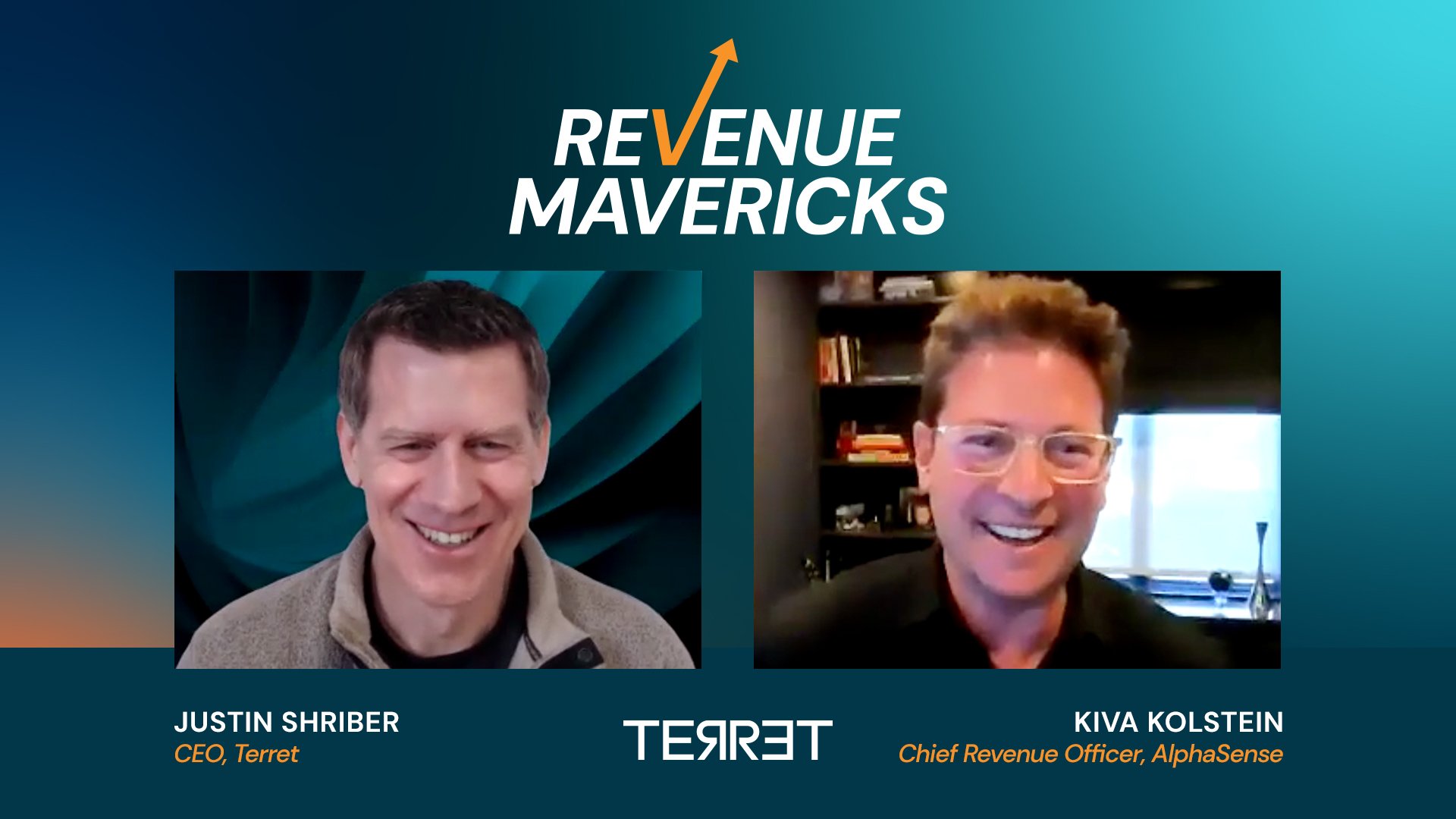
Why the Best Sales Leaders Build Environments, Not Just Teams: Lessons from AlphaSense's Kiva Kolstein

For a recent episode of Revenue Mavericks, I sat down with Kiva Kolstein, President and Chief Revenue Officer at AlphaSense, a company he has helped scale from 50 people and $10M in ARR to over 2,000 employees and $500M in ARR over nearly nine years.
His career has taken him through decades of sales leadership, four acquisitions, and one very uncomfortable 18-month detour into commercial real estate. But what stayed with me most wasn't the scale of what he's built. It was the intentionality behind how he builds it. Every interaction, every conversation, every moment of leadership, Kiva thinks carefully about how he shows up before he shows up.
1. What Parenting Taught Him About Leading
Kiva didn't point to a management course or a mentor when I asked about the experience outside of work that shaped him most as a leader. He pointed to his kids.
He has three children, two of whom are stepchildren he has been in the lives of for the past 12 years. They were 10 and 7 when he met them, not babies, which meant there was no gradual onboarding into the role. He had to figure out, deliberately and carefully, how to show up as a parent, a friend, a mentor, and a coach, all at once, to people who hadn't asked for him to be there.
What step-parenting forced on him was something he now considers one of his most valuable leadership assets: he never wings it.
"I think very carefully about the interaction I'm about to have, about the conversation I'm about to have. I prepare. I think about what my role will be in this conversation."
That level of intentionality, he told me, is different from how he approaches conversations with his biological son, where the relationship has a different foundation. With his stepchildren, every interaction is a choice to show up as the person they deserve. Twelve years in, he still prepares.
The translation to business leadership is direct. You can project confidence in a boardroom even when you don't feel it. You can perform authority in front of a team. But the people closest to you, whether at home or at work, feel the emotional temperature of the room immediately. There is no hiding. And if you accept that, it changes how you prepare.
2. The Back to Basics Chapter That Changed Everything
Kiva's most important career inflection point doesn't look like one on paper.
Several years into leading sales teams, with momentum, title, and visibility inside his organization, Kiva made a decision that made no logical sense: he left the tech world to join a commercial real estate firm as the most junior person on the team. His title was associate. His job was to make cold calls all day, every day, working through a database of every tenant in every building in Manhattan.
He knew almost immediately that he hated the industry. Commercial real estate, he realized, is purely transactional. You don't build anything. You don't shape a product or create a motion. You broker deals. That didn't energize him.
But the experience gave him something he hadn't realized he was missing.
After several years in leadership, Kiva had drifted from the field. Not intentionally. It just happens. Meetings replace calls. Strategy replaces execution. Coaching replaces doing. And when that drift goes unchecked, leaders lose touch with what the job actually feels like from the inside.
For 18 months, with no team to hide behind and no title to lean on, Kiva dialed. He got rejected. He dialed again. He learned, again, how hard cold outreach really is, how mentally exhausting rejection can be, and what it actually takes to generate something from nothing.
He has carried that experience for the past 20 years. It shows up when he coaches someone through a rough patch. It shows up when he needs to remind himself what grinding actually requires. It was a step backward that became one of the most important forward moves of his career.
3. The Framework He Runs Everything Through
When I asked Kiva about the operating principles that have driven growth at AlphaSense, he walked me through a framework he calls the Four Ps: Purpose, Power, Precision, and Presence.
Purpose is the anchor. If people cannot connect what they do every day to something larger than their quota or their OKR, everything breaks the moment things get hard. Kiva's personal purpose at AlphaSense, after nearly nine years, is still the belief that they are building something generational. Something people will look back on in 20 years and say changed how work gets done. That belief, he told me, is why he pushes for clarity over comfort and why standards matter to him as much as they do.
Power is capability. Ambition without substance is noise. You can have all the purpose in the world, but if the product doesn't solve a real problem, if the team isn't strong, if your resources don't match your aspirations, the market will expose you. Power is what turns belief into momentum.
Precision is where most organizations leave the most on the table. Playbooks, pre-call planning, discovery frameworks, deal progression criteria, objection handling, none of it is glamorous. Some CEOs treat it as a cost they cannot measure. But precision is what turns talented people into predictable results. Without it, performance is personality-driven. With it, performance becomes system-driven. That is the difference between a team that wins a quarter and an organization that can scale.
Presence is the one Kiva talks about most. Before any important interaction, he asks himself one question: how do I need to show up right now? Sometimes the moment requires urgency. Sometimes it requires calm. Sometimes it requires someone willing to say the uncomfortable thing that moves the conversation forward. Presence is not about being louder. It is about being more intentional, and choosing your posture deliberately before you walk into the room.
When all four are aligned, he told me, everything shifts. Performance accelerates. Teams move with confidence instead of friction. And you stop building for the quarter and start building something that holds up over time.
Why This Matters
Kiva said something early in our conversation that I kept coming back to throughout the rest of it: great leaders build environments, and when you build the right environment, the people deliver the results.
The Four Ps are not a shortcut. They are the architecture of an environment where people can do their best work, at 50 employees or 2,000. What makes Kiva's approach worth paying attention to is that he has not just theorized about this. He has lived it, through acquisitions, through a deliberate step backward into the grind, through the patient, intentional work of earning trust in relationships where it was never assumed.
That is how you build something that lasts.
Listen to the full conversation on the Revenue Mavericks podcast.